
In my clinic, I often meet people who say, “Doctor, I feel stuck, but I can’t explain why.” A student may be scoring well yet hate the stream they chose. A parent may worry about a child who seems bright but struggles to focus.
In situations like these, a psychometric assessment often gives the first clear answer. Instead of guessing, you get structured, evidence-based insight into how your mind works.
What Is a Psychometric Assessment?
A psychometric assessment is a scientific way of measuring a person’s abilities, personality, interests, emotions, and behaviour. It uses standardised tools tested on large groups, so your results are compared against reliable norms, not someone’s opinion.
I like to explain it simply: it is not a pass-or-fail exam. There are no “wrong” personalities. Think of it as a map of your strengths, your blind spots, and the environments where you are most likely to do well.
Psychometric Test vs Psychometric Assessment: Is There a Difference?
Many people use these terms interchangeably, but there is a small difference. A psychometric test is a single tool, such as a personality questionnaire or an aptitude paper. A psychometric assessment is the complete process. It combines one or more tests with a clinical interview, observation, scoring, and a detailed explanation of what the results mean for your life.
A test gives you numbers. An assessment gives you meaning, and that is where the real value lies.
Which Tests Does a Psychometric Assessment Cover?
The right test for psychometric assessment depends on why you came in. Here are the areas we usually cover:
Psychometric Assessments Which Are Available Online
- Intake Assessment: Case history, Mental Status Examination (MSE), general counseling & guidance
- Career Assessment & Counseling: Interest Test (SDS), Personality (NEO-FFI), Ability (DAT)
- Semi-Projective Tests: SSCT, RISB, Raven’s Controlled Projective Test
- Clinical Screening Scales: Anxiety, Depression, OCD, Mania, Psychosis, Trauma
- Personality Tests: MCMI-3, MMPI-2, MMPI-3, MACI, 16PF, HSPQ, SCID, IPDE, CPQ, CAQ, TCI, EPQ
- Memory Tests: PGI-MS, WMS
- Autism Spectrum Disorder (Adults): CARS, ISAA, INCLEN-ASD
- ADHD Assessment (Adults): DIVA, Conners, Vanderbilt, ADHD Checklist-4, INCLEN-ADHD
Psychometric Assessments Which are Available Offline
- Intake Assessment: Case history, Mental Status Examination (MSE), general counseling & guidance
- Developmental Delays: DST, GDS, VSMS, VABS, IQ tests (SFBT, GDT)
- Autism Spectrum Disorder: CARS, ISAA, INCLEN-ASD
- ADHD Assessment: Conners, Vanderbilt, ADHD Checklist-4, INCLEN-ADHD
- IQ Testing: MISIC, WISC, BKT, RPM, WAIS, WAPIS, Bhatia Battery
- Learning Disability: DTLD, NIMHANS SLD Index, WRAT, WJ
- Behavioral Concerns: CBCL
- Career Assessment & Counseling: Interest Test (SDS), Personality (NEO-FFI), Ability (DAT)
- Projective Tests: DAPT, HTP, KDS, TAT, CAT-A, CAT-H, Rorschach Inkblot Test
- Semi-Projective Tests: SSCT, RISB, Raven’s Controlled Projective Test
- Mental Retardation Screening: BASIC-MR, BASAL-MR
- Clinical Screening Scales: Anxiety, Depression, OCD, Mania, Psychosis, Trauma
- Neuropsychological Tests: Bender-Gestalt Test, MMSE, MOCA, ACE, AIIMS Battery, PGI-BBD
- Personality Tests: MCMI-3, MMPI-2, MMPI-3, MACI, 16PF, HSPQ, SCID, IPDE, CPQ, CAQ, TCI, EPQ
- Memory Tests: PGI-MS, WMS
Not everyone needs every test. I select them after understanding your concerns, so you don’t spend time and money on tools that add nothing.
For more, visit: https://drvatsalsuchak.com/services/psychometric-assessment/
Who Should Consider a Psychometric Assessment?
From my experience, these groups benefit the most:
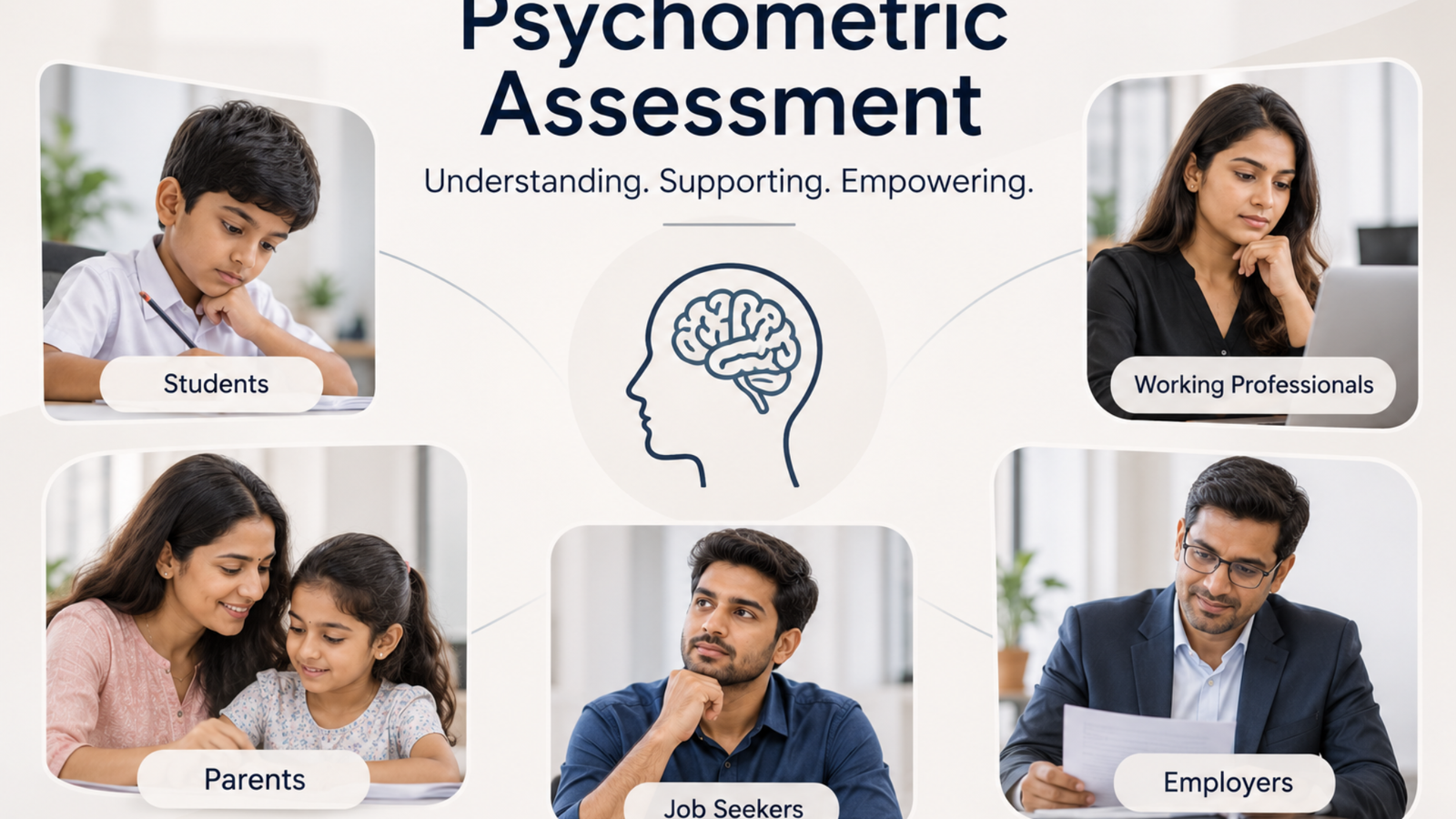
Students (Class 8 onwards). Choosing a stream or a course is a big decision. An assessment shows where a teenager’s aptitude and interest overlap, which prevents years of regret.
Working professionals. If you are considering a career switch, a leadership role, or you feel burnt out, an assessment helps you see whether the problem is the job, the role, or something deeper.
Parents. If your child struggles with studies, attention, or behaviour, a psychometric assessment can separate a learning difficulty from a simple lack of interest.
Job seekers and employers. Many organisations use a psychometric test in hiring. Preparing with a professional gives you confidence and self-awareness before you walk in.
Anyone feeling stuck. Sometimes the most useful thing is simply to understand yourself better.
What Happens During Your Assessment?
I keep the process comfortable and unhurried:
- A short conversation. We talk about your background, concerns, and goals.
- Test selection. I choose the tools that fit your situation.
- The assessment itself. Most people complete it in one or two sittings, in a calm setting.
- Scoring and interpretation. I look at your results together, not in isolation.
- A feedback session. I explain your report in plain language and give practical next steps.
Your results are confidential. They are shared only with you, or with a parent in the case of a minor.
Why a Professional-Led Assessment Matters
Online quizzes are tempting because they are quick and free. But I have seen many people make serious decisions based on a ten-minute internet quiz. These tools are rarely validated, and the results can be misleading.
A professionally administered assessment uses reliable, standardised tools, and a doctor reads the results in the context of your life. A number on a page means little unless someone helps you understand it. Taking a psychometric test with proper guidance protects you from wrong conclusions.
Take the Next Step Today
If you have been asking yourself, “What am I really good at?” or “Is my child on the right track?”, you don’t have to keep guessing. A psychometric assessment can bring clarity within days, not years.
Ready to begin? Book your consultation with Dr Vatsal Suchak today and take the first step toward clear, confident decisions.
Book your consultation today: https://drvatsalsuchak.com/contact/
About Dr Vatsal Suchak
Dr Vatsal Suchak is a doctor who believes that good decisions begin with self-understanding. His approach is simple: listen carefully, assess scientifically, and explain clearly. Whether you are a student, a parent, or a working professional, you will get honest, practical guidance without jargon or pressure. Every assessment is tailored to the individual, because no two people are alike.
Frequently Asked Questions
1. What is a psychometric assessment?
It is a structured, scientific evaluation of your abilities, personality, interests, and emotional functioning, using standardised tools and a professional interpretation.
2. Is a psychometric test the same as an IQ test?
No. An IQ test is only one type of psychometric test. A full assessment may also include personality, aptitude, interest, and emotional measures.
3. How long does a psychometric assessment test take?
It usually takes two to four hours, depending on the number of tests. It can be done in one sitting or split into two sessions.
4. Can I prepare for a psychometric assessment?
You can’t “study” for it, and you shouldn’t try to. Come well-rested, answer honestly, and don’t try to guess the “right” answers. Honest responses give the most useful results.
5. At what age can a child take a psychometric test?
Some tools are suitable from early school age, while career-related tests are most useful from Class 8 or 9 onwards. I recommend the right tools based on the child’s age.
6. Is the psychometric assessment report confidential?
Yes. Your report is private and shared only with you, or with a parent or guardian if the person assessed is a minor.
7. What is the right test for psychometric assessment in career guidance?
A combination usually works best: an aptitude test, a personality measure, and a career interest inventory. Together they give a balanced picture.
8. Can a psychometric assessment diagnose a mental health condition?
Some scales screen for concerns like anxiety, depression, or attention difficulties. However, a diagnosis comes only after a full clinical evaluation, not from test scores alone.